
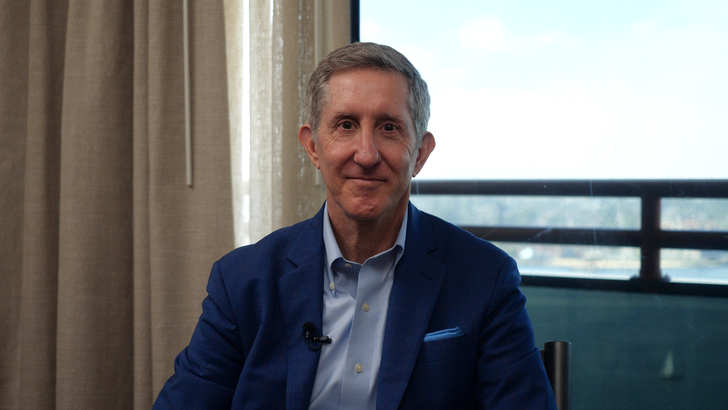
This video brief features Dr. Jonathan Meyer reporting from the Psych Congress 2025 in San Diego with subgroup insights from a post hoc analysis of the 48-week KINECT-4 trial of once-daily valbenazine in adults with tardive dyskinesia (TD). The analysis evaluated treatment response by race and ethnicity, including Hispanic/Latino, non-Hispanic White, and non-Hispanic non-White participants. Dr. Meyer highlights the study’s key efficacy and safety endpoints and distills the clinical relevance of these findings for treating diverse patient populations with TD.
Valbenazine for TD: Consistent Long-Term Efficacy Across Racial and Ethnic Subgroups in KINECT-4

Transcript
Valbenazine for TD: Consistent Long-Term Efficacy Across Racial and Ethnic Subgroups in KINECT-4
closeTranscript
Valbenazine for TD: Consistent Long-Term Efficacy Across Racial and Ethnic Subgroups in KINECT-4
closeTranscript
Valbenazine for TD: Consistent Long-Term Efficacy Across Racial and Ethnic Subgroups in KINECT-4
closeAnnouncer:
Welcome to DataPulse from Psych Congress 2025 on ReachMD. This activity, titled Valbenazine for Tardive Dyskinesia: Consistent Long-Term Efficacy Across Racial and Ethnic Subgroups in KINECT 4, is provided by Total CME.
Dr. Meyer:
Hello from Psych Congress 2025 here in San Diego. I'm Dr. Jonathan Meyer, and today I'm sharing some new subgroup findings from KINECT 4, a long-term trial of once-daily valbenazine for tardive dyskinesia, or TD. Today's focus is on how treatment outcomes vary—or don't—across various racial and ethnic groups.
Here's the study design: KINECT 4 was a 48-week open-label study of once-daily Valbenazine 40 or 80 mg, in adults with TD. This post hoc analysis evaluated efficacy and safety by self-identified race and ethnicity.
The key findings were that all subgroups showed robust and clinically meaningful reductions in their AIMS total score. For the Hispanic/Latino group, 10.5-point reductions; for the non-Hispanic/non-whites, 10.0; and for the other group, 10.7. Importantly, the global improvement was also consistent with the change in the AIMS scores.
If we look at the CGI-TD for those people who had scores of 2 or less, it was the same across all the groups: numerically, 97.7% for the Hispanic/Latino, 100% for the non-Hispanic/non-white, and 82.1% for the non-Hispanic/white. The patient-rated improvement, as PGIC using the score of 2 or less, was also very similar across the three groups, respectively: 93.0%, 81.0%, and 87.2%.
The safety findings, including treatment-emergent adverse effects, serious treatment-emergent adverse effects, and discontinuations, were generally comparable across all of the subgroups.
I think the most important concept here is that we are in a society with a lot of different individuals, and the response to valbenazine once daily does not really vary across subgroups, regardless of their ethnicity or racial heritage. And I think this will give you confidence as you approach people who need treatment and not be overly concerned that there are any significant differences in drug metabolism or pharmacodynamic response, which would necessarily impinge or affect your choice of medication for tardive dyskinesia.
From the Psych Congress 2025, I'm Dr. Jonathan Meyer. Thank you for listening.
Announcer:
Thank you for listening to this DataPulse from Psych Congress 2025 on ReachMD. This activity is provided by Total CME. Thank you for listening.
Ready to Claim Your Credits?
You have attempts to pass this post-test. Take your time and review carefully before submitting.
Good luck!
Overview
Provider(s)/Educational Partner(s)

It’s about time! Today’s on-the-go learners have minutes to spend on education instead of hours. Total CME is an award-winning, global healthcare education company that strategically pioneers methodology, initiatives, and platforms to meet these time-limited needs. Unlike other medical education companies, Total CME employs a microlearning approach and platform to create outcome-based curricula that motivates HCPs to engage in self-directed point-of-care learning that impacts change in real time. Even while reaching the largest global distribution, we provide the most personalized, seamless learner experience. We’re meeting our busy learners where they are so they can focus on what they want when they need it, ultimately leading to behavior changes that impact clinical practice and empower patients in their own care.Commercial Support
This activity is supported by an independent educational grant from Neurocrine Biosciences, Inc.
videoValbenazine and Patient-Centered Outcomes in TD: Insights From the KINECT-PRO Study
Show more
Overview
This video brief features Dr. Jonathan Meyer reporting from the Psych Congress 2025 in San Diego with subgroup insights from a post hoc analysis of the 48-week KINECT-4 trial of once-daily valbenazine in adults with tardive dyskinesia (TD). The analysis evaluated treatment response by race and ethnicity, including Hispanic/Latino, non-Hispanic White, and non-Hispanic non-White participants. Dr. Meyer highlights the study’s key efficacy and safety endpoints and distills the clinical relevance of these findings for treating diverse patient populations with TD.
Provider(s)/Educational Partner(s)

It’s about time! Today’s on-the-go learners have minutes to spend on education instead of hours. Total CME is an award-winning, global healthcare education company that strategically pioneers methodology, initiatives, and platforms to meet these time-limited needs. Unlike other medical education companies, Total CME employs a microlearning approach and platform to create outcome-based curricula that motivates HCPs to engage in self-directed point-of-care learning that impacts change in real time. Even while reaching the largest global distribution, we provide the most personalized, seamless learner experience. We’re meeting our busy learners where they are so they can focus on what they want when they need it, ultimately leading to behavior changes that impact clinical practice and empower patients in their own care.Commercial Support
This activity is supported by an independent educational grant from Neurocrine Biosciences, Inc.
videoValbenazine and Patient-Centered Outcomes in TD: Insights From the KINECT-PRO Study
Show more
Title
Share on ReachMD
CloseProgram Chapters
Segment Chapters
Playlist:
Recommended
We’re glad to see you’re enjoying ReachMD…
but how about a more personalized experience?

